Receivables Guide: Key Concepts and Practical Management
Receivables management is a practical framework for turning outstanding customer payments into reliable cash flow. This guide defines “receivables” in accounting terms, explains how analysts interpret them using Receivables Investopedia-style references, and shows how to reduce collection risk with disciplined credit and reporting. Background covers measurement, recognition, and why aging matters.

1) Why receivables deserve immediate attention
Receivables management determines how quickly a business converts recorded sales into cash, directly influencing liquidity, working-capital planning, and financial stability. In accounting and finance education—often summarized in reference materials such as Receivables Investopedia concept pages—receivables represent amounts customers owe the company for goods or services delivered on credit. When these balances grow faster than collections, the result is not merely “more assets,” but potentially higher collection risk, cash shortfalls, pressured supplier payments, delayed payroll, and a reduced ability to invest in growth initiatives.
From an industry expert perspective, the goal is not only to record receivables correctly, but to run a repeatable system: credit policy, invoicing discipline, collection workflows, and ongoing credit-loss estimation. This is why “receivables” should be treated as an operational asset, not a passive line item. A company can show healthy revenue trends while silently accumulating receivables that are increasingly difficult to collect, which can later force painful write-downs or allowance increases. That late-stage recognition can be disruptive to forecasting, debt covenant performance, and budgeting cycles.
Immediate attention is also necessary because receivables often represent a large portion of total current assets for many industries. In B2B settings, it is common for receivables to be the dominant driver of short-term liquidity. In sectors with long contract terms or heavy invoice volumes—such as manufacturing, distribution, staffing services, SaaS with enterprise billing, utilities, telecom, construction, and equipment leasing—cash realization can become a direct function of how well invoices are issued and disputes are managed.
In practical terms, receivables deserve attention for four overlapping reasons. First, they determine cash timing: revenue recognition and cash receipt rarely align perfectly. Second, they influence working capital: money tied up in receivables reduces the funds available for inventory, payroll, and payables. Third, they reveal credit risk: delinquency patterns can serve as early warnings of customer stress or contract friction. Fourth, they affect financial reporting credibility: estimates for allowance/impairment must be supportable and current, and governance must stand up to audit scrutiny.
All of these factors make receivables management a continuous operational discipline rather than a quarterly “finance activity.” A robust receivables system reduces surprise and improves predictability—two qualities that matter to executives, board members, lenders, and trade creditors alike.
2) What “receivables” means in core accounting practice
In standard financial reporting, receivables typically include amounts expected to be collected from others—most commonly customers—within a defined period. While the term can be broad, in most business contexts the most important category is customer-related balances arising from normal operations.
Receivables typically include:
- Trade receivables (amounts owed by customers for ordinary business transactions, often supported by invoices or delivery/acceptance documentation).
- Other receivables (depending on reporting practices: tax refunds, advances to suppliers, interest receivable, lease receivable components, employee receivables, or miscellaneous claims).
- Notes receivable (where a customer issues a formal promissory note, rather than an open invoice, sometimes implying different credit terms and documentation).
The crucial feature is timing: receivables exist because revenue recognition and cash receipt do not occur on the exact same date. That timing gap makes receivables a bridge between accounting profit and real cash generation. However, bridging is not the same as guaranteeing. The “bridge” can become unstable if collection slows, terms are renegotiated, or disputes remain unresolved.
It is also useful to understand how receivables are presented. Many reporting approaches require receivables to be shown net of an allowance for expected credit losses (or impairment). This net presentation emphasizes that receivables are not simply “what we billed,” but “what we reasonably expect to collect.” That expectation should be backed by evidence, segmentation, and documented logic.
Beyond balance sheet presentation, receivables should be interpreted together with revenue and cash flow. If revenue rises and receivables rise at the same pace, the cash conversion may be stable. If revenue is flat but receivables rise, or if receivables rise faster than revenue, that can indicate operational breakdowns—billing delays, product/service acceptance issues, or weakened collection effectiveness—or it can indicate credit policy changes that increase risk exposure.
3) How receivables are analyzed: investors and credit teams look beyond totals
When stakeholders evaluate receivables, they rarely focus only on the aggregate number. Instead, they examine quality, collectability, and the trend of aging. A “healthy” balance usually means:
- Reasonable days outstanding relative to the company’s credit terms (and consistent with industry norms).
- Stable or improving aging profiles (fewer invoices stuck in older buckets).
- Appropriate allowance for expected credit losses reflecting current conditions and forward-looking information.
- Strong collection governance—clear ownership, documentation, and escalation steps.
A key nuance is that receivables quality can differ greatly even when totals look similar. Two companies may each report $10 million in receivables, but one might have most invoices within the agreed payment period, while the other might have a significant portion in late buckets that are likely to require renegotiation or write-off.
From an investor perspective, receivables analysis often includes:
- Cash conversion reliability: Do receivables convert to cash in a predictable timeframe, or are there recurring delays?
- Balance sheet risk: Does the company need additional financing due to cash tied up in receivables?
- Revenue sustainability: Are sales being created with acceptable credit terms, or is the company extending credit too aggressively?
From a credit team perspective (both internal credit and external analysts), the emphasis may be on customer-specific risk factors: payment behavior history, disputes, concentration, contractual rights, and collateral or guarantees (when available). In regulated or high-dispute environments—such as construction, healthcare billing segments, telecom interconnects, or complex enterprise implementations—dispute rates and resolution timelines can dominate receivables collectability.
If a firm shows rising receivables while sales remain flat, analysts often ask whether credit is being extended more aggressively—or whether collections are weakening. That concern is especially relevant in sectors where invoices can be disputed, or where procurement cycles create longer payment lags. It is also relevant when operational changes occur: ERP migrations, billing process redesigns, or contract renegotiations can create temporary “noise” in receivables aging, but persistent misalignment can indicate deeper problems.
4) Measurement and recognition: the allowance is where risk becomes visible
Many modern reporting frameworks require companies to recognize expected credit losses rather than waiting for a “loss event” to occur. The exact mechanics depend on the applicable accounting standard (for example, IFRS models such as expected credit loss approaches, or U.S. GAAP qualitative and quantitative components).
Practically, this means receivables management is inseparable from impairment/allowance estimation. A disciplined approach typically combines:
- Historical loss experience (often segmented by customer group, geography, industry, and/or aging bucket).
- Current and forward-looking information (e.g., changes in customer payment behavior, macro conditions like unemployment or interest rates, regulatory changes affecting customer liquidity, or industry-specific stress indicators).
- Reasonable supportable assumptions documented for audit purposes, including how assumptions are updated and how they relate to observed outcomes.
For readers encountering Receivables Investopedia summaries, the key takeaway is that receivables should be presented net of credit risk effects—because gross amounts can hide collectability problems. A “gross receivables” number can look strong while the allowance captures a portion of risk. The allowance itself should not be treated as an accounting afterthought; it reflects how the organization interprets risk and how well its estimation method matches reality.
Allowance estimation is also a governance exercise. Companies need clear roles: someone must own data extraction, someone must define methodology, someone must challenge assumptions, and someone must sign off on the outcome. Without governance, allowances can become too optimistic or too conservative, and the variance explanation becomes difficult to justify.
Allowance estimation can be impacted by several operational realities:
- Dispute-driven timing: invoices might appear delinquent because payments are withheld pending acceptance, credits, or dispute resolution.
- Revised credit terms: renegotiations can extend payment periods, shifting invoices into later aging buckets.
- Concentration risk: a few large customers may dominate exposure; if they deteriorate, loss expectations should update quickly.
- Customer-specific events: bankruptcies, restructuring, or insolvency proceedings require special treatment.
When the allowance estimation method is aligned with actual operational behavior—meaning it accounts for disputes, renegotiations, and customer outcomes—the financial reporting becomes more reliable. When it is not aligned, surprises appear later, and the business may face both cash issues and earnings volatility.
5) Operations: turning invoices into cash is a workflow problem
From an operational lens, receivables are influenced by controllable behaviors. A strong setup reduces friction between sales, billing, and collections. Common top-practice levers include:
- Invoice accuracy: correct contract references, correct billing period, correct pricing, and complete documentation reduce payment disputes. Accuracy is not only about arithmetic; it’s about making it easy for customers to validate and pay.
- Credit approval discipline: credit is a risk decision; it should not be automatic, and it should match order terms. Overriding credit rules can create hidden exposure.
- Timely invoicing: delaying invoices can be indistinguishable from “slow collections” in a cash forecast. Even when the contract is correct, a delayed invoice can shift days outstanding.
- Collection cadence: consistent reminders, escalation paths, and customer-specific strategies. Cadence should not be random; it should be predictable and tied to aging.
- Dispute resolution speed: disputes often sit at the intersection of operations and credit risk. If disputes are not resolved quickly, invoices age, and collectability assumptions must change.
Industry practitioners often describe receivables as “a mirror of execution.” If delivery confirmation and billing processes are clean, receivables tend to behave more predictably. If there are recurring invoice errors, unclear service acceptance criteria, or inconsistent contract interpretation, receivables will reflect that friction through delays and disputes.
Operational excellence in receivables often involves designing the workflow so that each department understands the handoff points. For example:
- Sales should ensure contract terms are clear—especially around acceptance, invoicing triggers, and credit limits.
- Operations should ensure delivery or service milestones are documented so invoices can be raised accurately.
- Billing should ensure invoices go out promptly and contain complete, customer-friendly details.
- Collections should have quick access to dispute status and customer contact history.
- Finance should maintain accurate posting, reconciliation, and allowance governance.
Another operational element is communication. Customers often pay faster when they are engaged appropriately. Collections teams that combine polite persistence with clarity (what is due, why it is due, what documentation is needed, and what happens next) tend to reduce escalation costs and prevent small issues from turning into larger disputes.
For businesses with high invoice volumes, automation can further improve speed and consistency. Automated invoice delivery, payment reminders, and status updates can reduce the time between “invoice sent” and “customer aware.” However, automation must be controlled so that customers are not spammed and so that disputes are handled with human review.
6) Industry perspective: receivables quality affects valuation and resilience
Although receivables are recorded as assets, their economic value depends on collectability and timing. For credit analysts, weaker receivables can indicate that revenue is being generated with stricter collection risk, or that customer base quality is changing. For equity investors, receivables quality can influence:
- Affordable cash flow reliability (cash realization versus accounting earnings). If earnings rise but cash conversion weakens, valuation models may need adjustment.
- Working capital volatility (cash tied up in receivables). Volatile working capital can destabilize free cash flow.
- Balance-sheet risk (need for financing or vendor payables strain). Persistent receivables buildup may increase reliance on credit facilities.
Reliable disclosure and transparent allowance methodologies can reduce uncertainty. Where information is limited, analysts may apply more conservative interpretations of receivables aging. For example, if the allowance methodology is opaque, or if there is no clear explanation of changes in impairment estimates, analysts may not trust that the balance sheet captures the true risk.
Different industries face different receivables characteristics. In subscription-based SaaS, receivables may be tied to billing cycles and churn behavior, with relatively predictable patterns (though disputes over renewals, overages, or service credits can still occur). In manufacturing and distribution, receivables may be influenced by credit terms and order fulfillment processes, with disputes typically arising around shipping, quantity discrepancies, or chargebacks. In project-based industries (construction, engineering, consulting), receivables can be heavily affected by acceptance procedures, change orders, and withholding of payment pending milestone completion.
Valuation models increasingly consider cash flow quality. A company that consistently converts receivables into cash may be viewed as having better earnings quality. Conversely, if receivables are repeatedly “rescued” by renegotiating terms, extending due dates, or relying on late-stage financing, analysts may discount the sustainability of growth.
Resilience also matters. Resilient receivables management means the business can withstand customer stress without runaway allowance increases or severe liquidity constraints. Resilience is typically achieved through early detection (aging and customer monitoring), proactive dispute resolution, realistic credit terms, and disciplined credit-loss estimation.
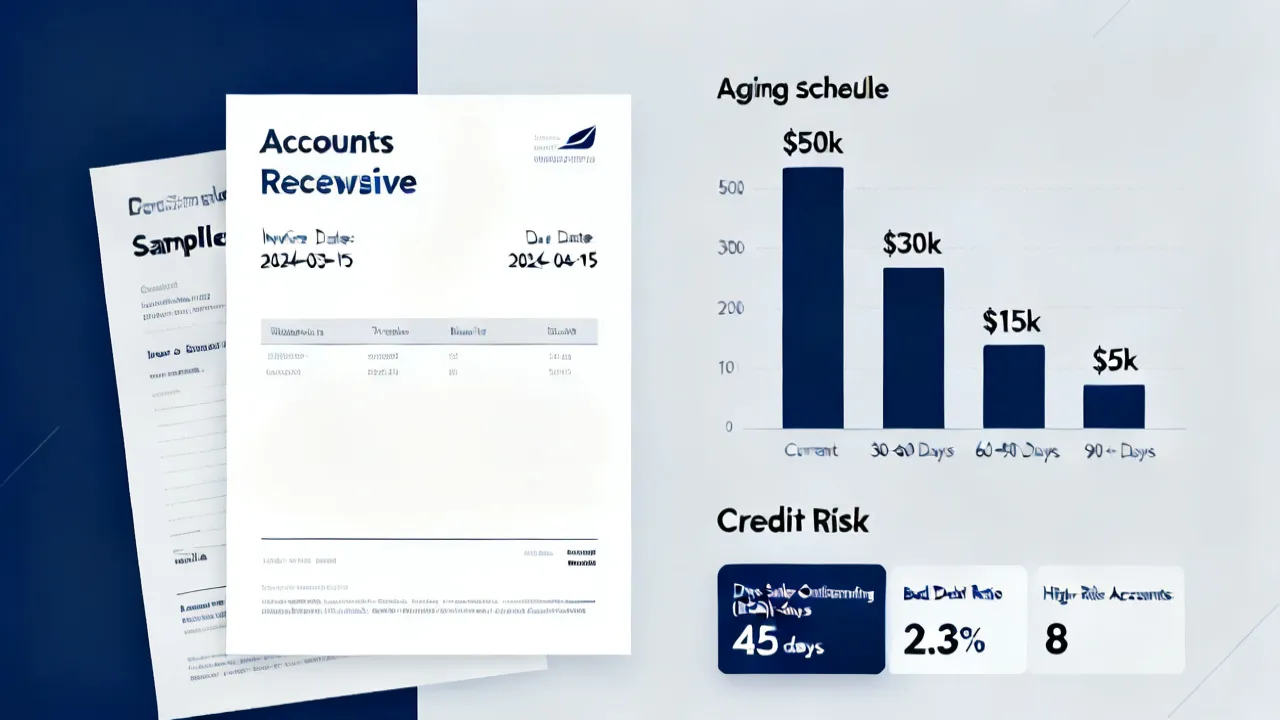
7) Receivables aging: the very practical dashboard for day-to-day decisions
Aging schedules—grouping outstanding invoices by how long they have been unpaid—often provide the clearest operational signals. For example, a rising share of balances in later aging buckets may suggest:
- Customers are paying more slowly than before (behavioral deterioration).
- There are systemic billing issues causing disputes (process failures).
- Credit limits may be misaligned to customer risk (policy gaps).
Conversely, aging stability alongside revenue growth can indicate that collections processes scale effectively. For day-to-day management, aging dashboards are essential because they allow teams to prioritize work. A business typically cannot—and should not—treat all invoices equally. Aging helps identify which accounts require urgent outreach, which require escalation, and which are suitable for automated reminders.
However, aging must be interpreted carefully. A large portion in “current but not yet due” may be normal if sales recently increased. A large portion in “0–30 days” might still be acceptable if payment terms are 60 days. Meanwhile, invoices in older buckets may not be purely delinquent—they might be in dispute, subject to credits, or waiting for acceptance documentation.
Therefore, many organizations use additional layers beyond basic aging:
- Dispute tagging: identifying whether an invoice is disputed or disputed partially.
- Collection status: categorizing invoices as “in collections,” “escalated,” “on hold pending documentation,” or “ready for legal action.”
- Customer segment: grouping aging patterns by customer type (e.g., public sector, enterprise, SMB, channel partner, geographic region).
- Invoice reason codes: linking aging to causes like pricing disputes, delivery mismatch, or contract terms confusion.
These enhancements help avoid a common risk: misdiagnosing the cause of aging deterioration. When aging worsens, leadership often wants quick answers. Good analytics can separate “true delinquency” from “administrative delay” and from “dispute-driven nonpayment.”
Operationally, aging also supports staffing decisions. If a company sees predictable seasonal aging patterns, it can allocate collection resources accordingly. If new invoice volumes cause aging to shift rapidly, it may indicate process bottlenecks that should be addressed immediately—such as delays in delivery confirmations, invoicing batch timing, or insufficient capacity in accounts receivable operations.
8) Practical controls: policies, people, and documentation
Expert teams treat receivables management as a governance framework. Instead of relying on individual follow-up habits, companies institutionalize:
- Clear credit policy defining eligibility, limits, required approvals, and conditions for granting terms. A policy should specify how to handle exceptions.
- Standardized invoicing packs that match delivery and contractual terms. In industries where customers require detailed supporting documentation, standardized packs reduce back-and-forth.
- Segmentation of customers by risk and payment patterns. Segmentation supports tailored collection strategies.
- Audit-ready documentation for allowance estimation and dispute history. This includes evidence for why a customer is considered low-risk or why losses are expected in certain buckets.
- Performance reporting for collections effectiveness and aging movement. Reporting should be frequent enough to allow corrective actions.
When these controls exist, receivables teams can focus time on exceptions—late payments, disputed invoices, and high-risk accounts—rather than chasing routine items that could be handled through automation or customer self-service portals.
People and responsibility are equally important. Many receivables problems occur at handoffs: sales approves terms, but billing does not receive necessary contract details; customer service knows there is a dispute, but collections does not; finance updates allowance methodology but does not incorporate new dispute patterns. Clear ownership and escalation protocols reduce these failure modes.
Good receivables governance also includes defined timelines. For instance:
- Invoices must be issued within a specified period after delivery/acceptance.
- Disputes must be logged and categorized immediately.
- Collections reminders should follow an aging-based cadence.
- Escalation to a manager should occur by a defined aging threshold.
- Legal or external recovery actions should require documented approval.
Documentation is not simply “for audit.” It is a practical tool for faster resolution. When disputes arise, having contract references, proof of delivery, and accurate billing details reduces investigation time and increases the likelihood of resolving issues quickly.
Finally, strong controls include feedback loops. If a certain type of invoice error leads to recurring disputes, the system should capture that pattern and trigger corrective action in upstream processes. Continuous improvement ensures that receivables aging does not become a repeating cycle of the same operational problems.
9) Common pitfalls that weaken receivables performance
Even well-run organizations can struggle with receivables if they overlook common structural issues. Typical pitfalls include:
- Over-reliance on sales incentives without alignment to billing accuracy and collection outcomes. If sales compensation is driven solely by booked revenue, the company may expand credit exposure without sufficient discipline.
- Weak linkage between order terms and invoicing (e.g., billing not reflecting agreed deliverables). When billing does not reflect contract obligations, disputes become inevitable.
- Slow escalation on disputes, leading to “aging creep.” If a dispute languishes, customers become comfortable withholding payment.
- Inadequate customer segmentation, treating very different payment behaviors as if they were the same. Segmentation is essential for targeted approaches.
- Allowance estimation drift where assumptions become outdated compared to actual payment experience. Without model monitoring, allowance methodology can lag behind reality.
There are additional, more subtle pitfalls that can be equally damaging:
- Inconsistent customer master data (e.g., multiple accounts for the same customer, incorrect billing addresses, or missing tax IDs). Such inconsistencies can delay invoice delivery and slow payment processing.
- Unclear dispute ownership (customer service thinks finance will handle it; finance thinks collections will handle it). Disputes require a single accountable workflow owner.
- Insufficient visibility into cash application: if cash is received but posted late or incorrectly, invoices remain “unpaid” in the system even though cash arrived.
- Overly complex processes for credit approvals. If credit approvals are too slow, order fulfillment may be delayed, causing business friction—and then those delays may be followed by rushed approvals that increase risk.
- Legal and recovery procedures that are reactive rather than planned. When legal actions start only after extended aging, recovery may be weaker.
From a risk-management viewpoint, these issues reduce predictability of cash timing—often before accounting statements fully reflect the deterioration. This lag can create a false sense of stability: the P&L may look fine, while cash forecasts deteriorate rapidly due to receivables buildup.
Another pitfall is misreading the relationship between receivables and growth. Receivables naturally grow if sales grow, but they should not grow disproportionately without explanation. A consistent and credible explanation—such as a planned expansion into customers with longer payment terms—must be communicated to finance leadership and reflected in forecasting models.
10) How to use receivables metrics responsibly (without chasing misleading signals)
Many finance teams use ratios such as days sales outstanding (DSO), receivables turnover, or components of the cash conversion cycle. However, expert analysts emphasize context:
- Changes in payment terms can move DSO even if collections quality is unchanged. For example, if negotiated terms extend from net 30 to net 60, DSO can increase without indicating deterioration.
- Mix of customers (e.g., public-sector versus private-sector) affects typical payment behavior. A shift in customer mix changes baseline expectations.
- Billing timing can distort short-term comparisons. If invoicing is delayed due to operational reasons, DSO may appear worse temporarily.
Rather than treating metrics as standalone “scores,” professionals trend them alongside aging distribution and customer-level outcomes. A responsible approach includes:
- Triangulation: use DSO plus aging bucket counts plus dispute rates to understand what is driving change.
- Time-series awareness: compare like-for-like periods (adjusting for seasonality and accounting timing).
- Segment-level metrics: compute DSO by customer segment, geography, product line, or contract type where feasible.
- Qualitative checks: ask whether there have been operational process changes (billing system upgrades, acceptance process changes, or credit policy revisions).
It is also important to recognize that “improvement” in DSO can sometimes be misleading. If DSO falls because the company tightened credit terms but sales dropped, the receivables metric may look better while growth prospects deteriorate. Conversely, DSO may temporarily worsen due to planned growth into new customer segments with longer terms, even if the credit risk is managed appropriately.
Similarly, receivables turnover can be influenced by numerator/denominator effects. If revenue shifts dramatically or if receivables balance averages change due to timing, turnover may not reflect true collection performance. Responsible metric use involves analyzing the components rather than relying solely on the ratio.
A good practice is to create a “receivables performance pack” that includes: aging schedule, top delinquent accounts, dispute trends, cash application statistics, allowance movement, and explanations for variances versus prior periods. This provides context and prevents decision-making based on a single number.
11) Comparison and implementation supplements (table + source + guide + conditions)
To support practical decisions, the following section summarizes how receivables concepts and management actions typically differ across common scenarios. This comparison is intended as an operational supplement, not as a replacement for accounting standards or company policy. It also reflects common real-world patterns that credit and finance teams encounter when investigating why receivables performance changes.
| Scenario | What to prioritize in receivables | Typical operational signals | Management response |
|---|---|---|---|
| Steady growth in sales | Consistency of credit and invoicing workflow | Aging distribution remains stable; DSO trends in line with historical ranges | Maintain credit approval gates; monitor DSO trend; ensure invoicing cadence scales with sales |
| Receivables rise faster than revenue | Cash timing gap investigation | Higher late-bucket invoices; more disputes; longer time between delivery and invoice | Audit billing accuracy; tighten dispute resolution; reassess limits and credit terms; improve collection cadence |
| Higher concentration in a few customers | Risk segmentation and credit concentration controls | Large balances with inconsistent payment patterns; top accounts dominate aging risk | Review concentration thresholds; adjust credit terms; consider guarantees or credit insurance where appropriate; increase monitoring frequency |
| Macroeconomic stress | Allowance supportability and forward-looking assessment | Slower payments; increased customer financial difficulty indicators; higher probability of disputes | Update loss forecasts; document assumptions; validate with recent payment data and customer risk signals |
| Audit scrutiny on impairment/allowance | Documentation and governance | Inconsistent estimation methods or weak evidence trails; insufficient rationale for model updates | Strengthen controls, evidence, and model change logs; ensure alignment between operational data and impairment approach |
One additional implementation supplement is to ensure that the scenario-based actions are converted into actual tasks with owners. For example, “audit billing accuracy” should include a defined scope (which contracts, which products, which time period), a method (sample invoice testing, match to proof of delivery), and a remediation plan (fix templates, improve billing logic, retrain billing staff). “Update loss forecasts” should specify who updates the model, what data sources are used, how assumptions are validated, and how the allowance change is explained.
Sources and reference grounding (objective)
For conceptual definitions and accounting context, many readers consult educational summaries consistent with widely used reference materials such as Receivables Investopedia. For authoritative guidance on impairment and financial statement presentation, companies and auditors primarily rely on the applicable accounting standards (e.g., IFRS guidance for expected credit losses or U.S. GAAP impairment guidance), and on disclosures required in annual reports. Readers should review the specific standard applicable to their jurisdiction and reporting framework.
It is also valuable to align internal receivables policies with those standards. A company’s credit-loss estimation process should reflect the same logic used in financial reporting: how risk is measured, how information is incorporated, and how changes are justified. When internal collections and disputes tracking is granular, it can improve impairment estimation quality; when it is not, impairment estimates become more dependent on broad assumptions, which can increase audit friction.
Step-by-step guide: building a receivables management playbook
The following steps reflect widely adopted industry practice and can be adapted to company size and risk profile. A playbook should be written as a practical guide—not just policy text—so teams know exactly what to do, when to do it, and what evidence is required.
- Map your receivables lifecycle: from credit approval to order fulfillment to invoicing and collection. Identify where exceptions originate. Document handoffs, required fields, and failure points (e.g., contract terms missing from billing system).
- Segment customers: separate high-risk and low-risk accounts based on payment history, industry, and contractual terms. Consider segmentation by size, payment behavior, and dispute propensity—not only by revenue.
- Define credit policy clearly: credit limits, review frequency, required documentation, and approval authority. Include rules for exceptions: what must be approved, by whom, and what risk mitigation is required.
- Standardize invoicing: ensure accuracy, contract alignment, and completeness of supporting documents to reduce disputes. Create invoice templates aligned with common contract types and build in validation checks.
- Set collection cadence: choose timing for reminders, escalation points, and customer communication protocols. Use aging buckets to define when reminders shift from friendly to formal and when escalation begins.
- Track aging distribution weekly (or monthly): monitor movement between aging buckets and investigate drivers. Use aging “movement” rather than only end-of-period snapshots.
- Reconcile disputes quickly: assign ownership for disputed invoices and set deadlines for resolution. Ensure disputes are logged with reason codes and linked to expected resolution outcomes.
- Maintain allowance estimation governance: update assumptions regularly; document evidence; reconcile model outputs to actual outcomes. Run periodic back-testing of forecasts against actual cash receipts and charge-offs.
- Report performance to stakeholders: present aging trends, collection effectiveness, and allowance movement with clear explanations. Include a variance analysis section: what changed, why, and what corrective actions are underway.
As you implement the playbook, consider establishing a cadence for governance meetings. For example, a weekly operational review for receivables aging and disputes, and a monthly finance review for allowance movement and methodology validation. This creates consistent feedback loops and prevents delays in recognizing deterioration.
A complete playbook also includes templates and tools. Examples include: credit approval forms, invoice documentation checklists, dispute log templates, escalation scripts, customer outreach templates, and reporting dashboards. Teams are more likely to follow procedures when the materials are accessible and easy to use.
Finally, the playbook should include change management. If you upgrade ERP systems or modify invoicing workflows, plan a parallel run or transition period. Measure whether invoice accuracy and time to invoice change after the implementation. Without this, operational changes can temporarily worsen receivables aging, and leadership may misattribute the issue to credit risk.
Conditions and requirements to implement effectively
To ensure receivables controls are reliable and defensible, organizations typically require:
- Cross-functional ownership across sales, finance, billing operations, and customer service. Receivables are not solely an accounts receivable team responsibility.
- Documented credit policies aligned with contracts and procurement practices. Policies should be consistent with how customers are actually onboarded and approved.
- Consistent data quality for invoice status, payment postings, and customer master data. Poor data quality can create phantom delinquencies and distort aging.
- Audit-ready documentation supporting allowance estimation and dispute histories. Ensure evidence trails exist for major assumptions and for customer-specific conclusions.
- Training and escalation protocols so collections are handled consistently, not informally. Training should include how to handle customer objections and how to document communications.
Beyond these requirements, companies often need enabling technology and process design. For instance, a billing system that captures proof-of-delivery references and automatically attaches supporting documentation reduces dispute friction. A collections management tool can help track outreach, notes, and outcomes. Cash application automation can reduce misposting and improve transparency of what has been paid.
Technology alone does not solve receivables issues. The system must be configured correctly and maintained. Controls should ensure that payment posting rules are accurate, that invoice statuses are updated properly, and that customer records remain current. If automation is implemented without strong data governance, it can scale errors as quickly as it scales throughput.
It is also useful to define key performance indicators (KPIs) that align with the playbook objectives. Example KPIs include: percentage of invoices issued on time, dispute rate by contract type, average dispute resolution time, cash application accuracy, and delinquency rates by aging bucket. KPIs should be reviewed with action plans; metrics are only useful when they drive decisions and remediation.
FAQs
What are receivables, in simple terms?
Receivables are amounts owed to a company by customers for goods or services delivered on credit. They represent a timing difference between recognizing revenue and receiving cash.
How does receivables aging help management?
Aging schedules show how long invoices remain unpaid. They help teams detect collection deterioration early, identify dispute patterns, and focus attention on accounts very likely to become uncollectible.
What is the relationship between receivables and the allowance for credit losses?
Because not all receivables are expected to be collected, companies estimate expected credit losses and reflect them through an allowance. This affects how receivables are presented and how credit risk is measured.
Why can a business show “profit” while cash is tight due to receivables?
Accounting profit can be recognized when goods or services are delivered, but cash is received only after customers pay. If receivables grow and collection slows, cash may lag behind earnings.
Are receivables metrics like DSO always reliable?
They can be informative, but they must be interpreted in context—such as changes in payment terms, customer mix, invoicing timing, and billing disputes. Trends plus aging detail generally provide a more accurate view.
What operational steps typically reduce receivables risk?
Common steps include improving invoice accuracy, standardizing documentation, enforcing credit approval controls, accelerating dispute resolution, and maintaining a consistent collection cadence supported by clear escalation procedures.
Conclusion: treat receivables as an operational asset
Receivables are not just an accounting classification; they are an operational system that connects sales execution to cash outcomes. Aligning credit policy, invoicing accuracy, collections discipline, and allowance governance helps a business preserve liquidity while maintaining credible financial reporting. Whether you approach the topic through educational resources like Receivables Investopedia or through internal policy frameworks, the principles converge: collectability, timing, and documentation determine whether receivables truly strengthen the balance sheet.
When receivables management is proactive, organizations can reduce cash surprises, minimize credit losses, and improve transparency for auditors and investors. When it is reactive, receivables can become a hidden risk that only surfaces when cash is already constrained or when impairment adjustments are required. The difference is not complexity—it’s disciplined execution, consistent governance, and an emphasis on operational details that drive customer payment behavior.
Ultimately, strong receivables management supports growth. It enables a business to extend credit responsibly, scale invoicing and collections, and sustain financial stability even as customer relationships evolve. By treating receivables as a living operational asset—from the moment a credit decision is made to the final cash application and loss estimation process—leadership can protect both cash flow and reporting credibility in a way that supports sustainable performance.